Perhaps the most well-known concept in popular mathematics is the Fibonacci sequence. This is due in part to its elegant simplicity, but also to its application in several non-scientific fields, such as music or art. Some people attribute almost magical powers to it and claim that this sequence “rules the universe” or that it is “God’s fingerprint.” Unfortunately, however, misinformation about it is spreading on the internet, which I will address here. We are all probably familiar with this sequence, but I will explain it in the introduction just to be sure.
The Fibonacci sequence is defined by the formula:
F(0) = 0, F(1) = 1,
F(n) = F(n - 1) + F(n - 2).
This formula can be easily explained in words. The first two terms of this sequence are the numbers 0 and 1 (hence F(0) = 0 and F(1) = 1). Next, we add these two terms (i.e., 1 + 0) to get the third term of the sequence, which is the number 1. The sequence thus looks like this: 0, 1, 1. Next, we add the last two terms again (i.e., 1 + 1) to get the number 2. This gives us the sequence 0, 1, 1, 2. We add the last two terms again (i.e., 2 + 1) and add the resulting number back to the sequence. We continue this process indefinitely. The first few terms of this sequence look like this: 0, 1, 1, 2, 3, 5, 8, 13, 21, 34, 55, 89, 144, …
This sequence has beautiful mathematical properties. For example, if we take two consecutive numbers and calculate their ratio F(n + 1) / F(n), we obtain an approximation of the mathematical constant φ, i.e., the golden ratio. For example, 144 / 89 = 1.6179775280898876404494382022472, which is very close to the golden ratio. The larger the numbers we choose, the more accurate the approximation will be. Since φ is an irrational number (it has an infinite non-repeating decimal expansion), this approximation can never be absolutely exact.
Perhaps the best-known concept in popular mathematics is the Fibonacci sequence. This is due in part to its elegant simplicity, but also to its application in several non-scientific fields, such as music or art. Some people attribute almost magical powers to it and claim that this sequence “rules the universe” or that it is “God’s fingerprint.” Unfortunately, however, misinformation about it is spreading on the internet, which I will address here. We are all probably familiar with this sequence, but I will explain it in the introduction just to be sure.
The Fibonacci sequence is defined by the formula
F(0) = 0, F(1) = 1,
F(n) = F(n - 1) + F(n - 2).
This formula can be easily explained in words. The first two terms of this sequence are the numbers 0 and 1 (hence F(0) = 0 and F(1) = 1). Next, we add these two terms (i.e., 1 + 0) to get the third term of the sequence, which is the number 1. The sequence thus looks like this: 0, 1, 1. Next, we add the last two terms again (i.e., 1 + 1) to get the number 2. This gives us the sequence 0, 1, 1, 2. We add the last two terms again (i.e., 2 + 1) and add the resulting number back to the sequence. We continue this process indefinitely. The first few terms of this sequence look like this:
0, 1, 1, 2, 3, 5, 8, 13, 21, 34, 55, 89, 144, …
This sequence has beautiful mathematical properties. For example, if we take two consecutive numbers and calculate their ratio F(n + 1) / F(n), we obtain an approximation of the mathematical constant φ, i.e., the golden ratio. For example, 144 / 89 = 1.6179775280898876404494382022472, which is very close to the golden ratio. The larger the numbers we choose, the more accurate the approximation will be. Since φ is an irrational number (it has an infinite non-repeating decimal expansion), this approximation can never be absolutely exact.
This sequence can also be used to construct the very famous golden spiral. All you need to do is create a 1x1 square, then another 1x1 square, followed by a 2x2, 3x3, 5x5, 8x8 square… Then simply draw a quarter circle inside each square. This process is well illustrated in the animation below.

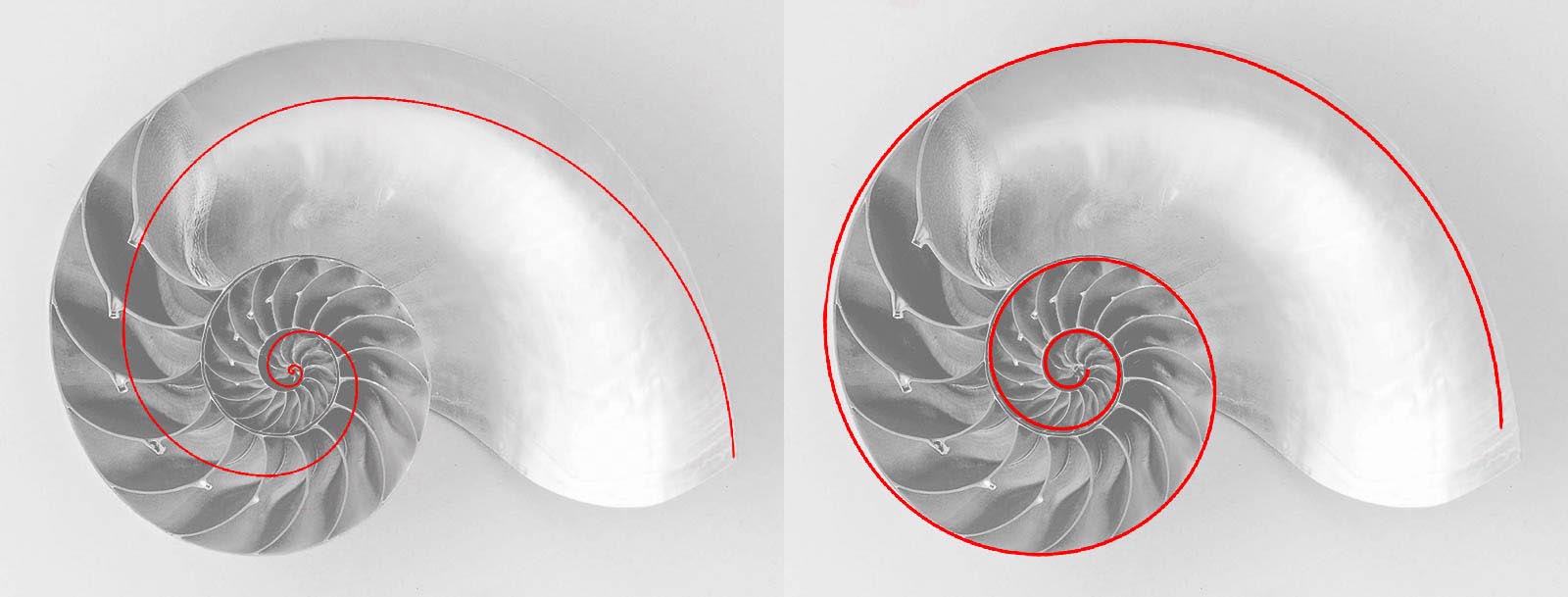
Here we can see the very first myth. I often see images online of a nautilus shell that is supposedly shaped like a Fibonacci spiral. But that is nonsense, and as is immediately apparent from the images below, this spiral does not correspond at all to the shape of this creature’s shell.
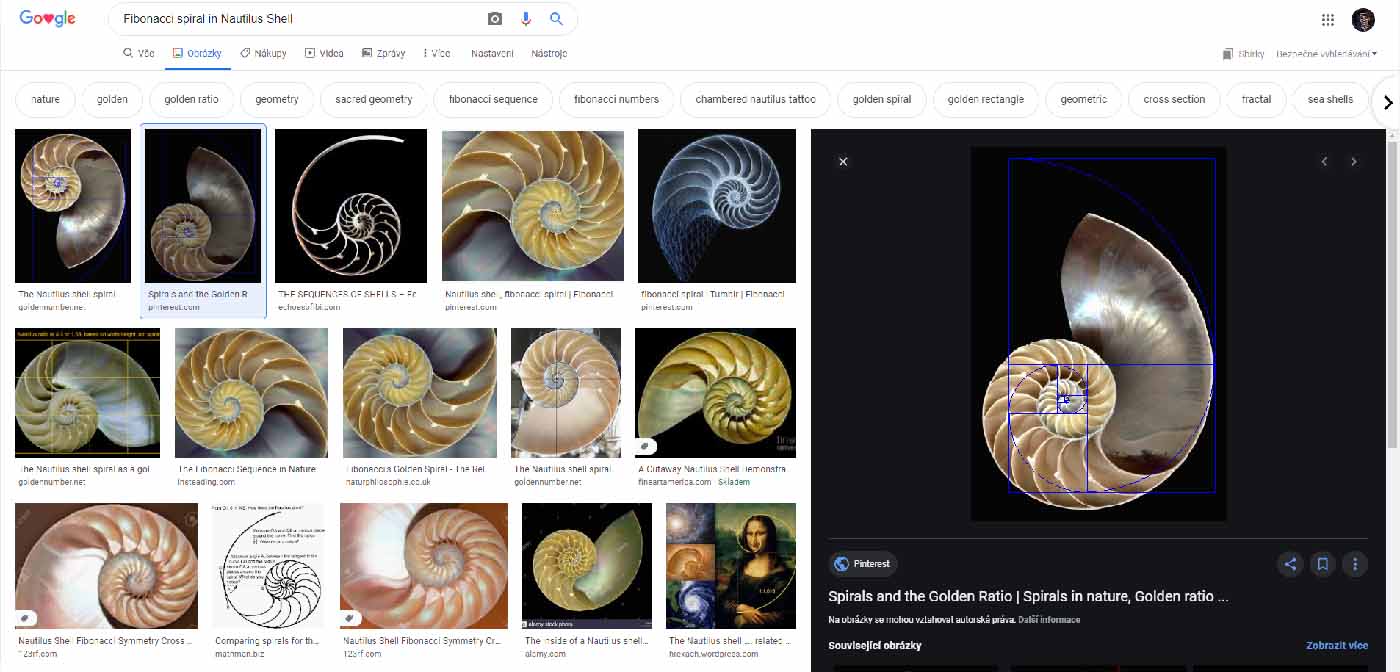
In reality, the nautilus does not have a shell shaped like a Fibonacci spiral (image on the left), but rather a logarithmic spiral (image on the right).
Another myth is the claim that the number of petals on plants is determined by the Fibonacci sequence. Proponents of this myth argue that while there are indeed flowers with a number of petals different from the terms of the Fibonacci sequence, they claim there are very few of them. I decided to test this claim, so I took a plant atlas and counted the number of petals on nearly every plant (I omitted some flowers because, for example, they have both male and female flowers with different numbers of petals or lack petals entirely). From a botanical point of view, however, the term “petal” is quite imprecise. What is colloquially called a petal is referred to in botany as a floral envelope. This is further divided into a corolla lobe and a calyx lobe (see the image below). Sometimes these two lobes are fused together, forming a single so-called petal.
So, in the Excel spreadsheet, I listed the number of corolla petals and sepals—or petals—next to the names of the flowers. Out of the 120 plants listed in the book Pocket ATLAS OF PLANTS by Albert Pilát and Otto Ušák, I entered 104 plants into the Excel spreadsheet. Using the Python programming language, I then created the graph below from this data.
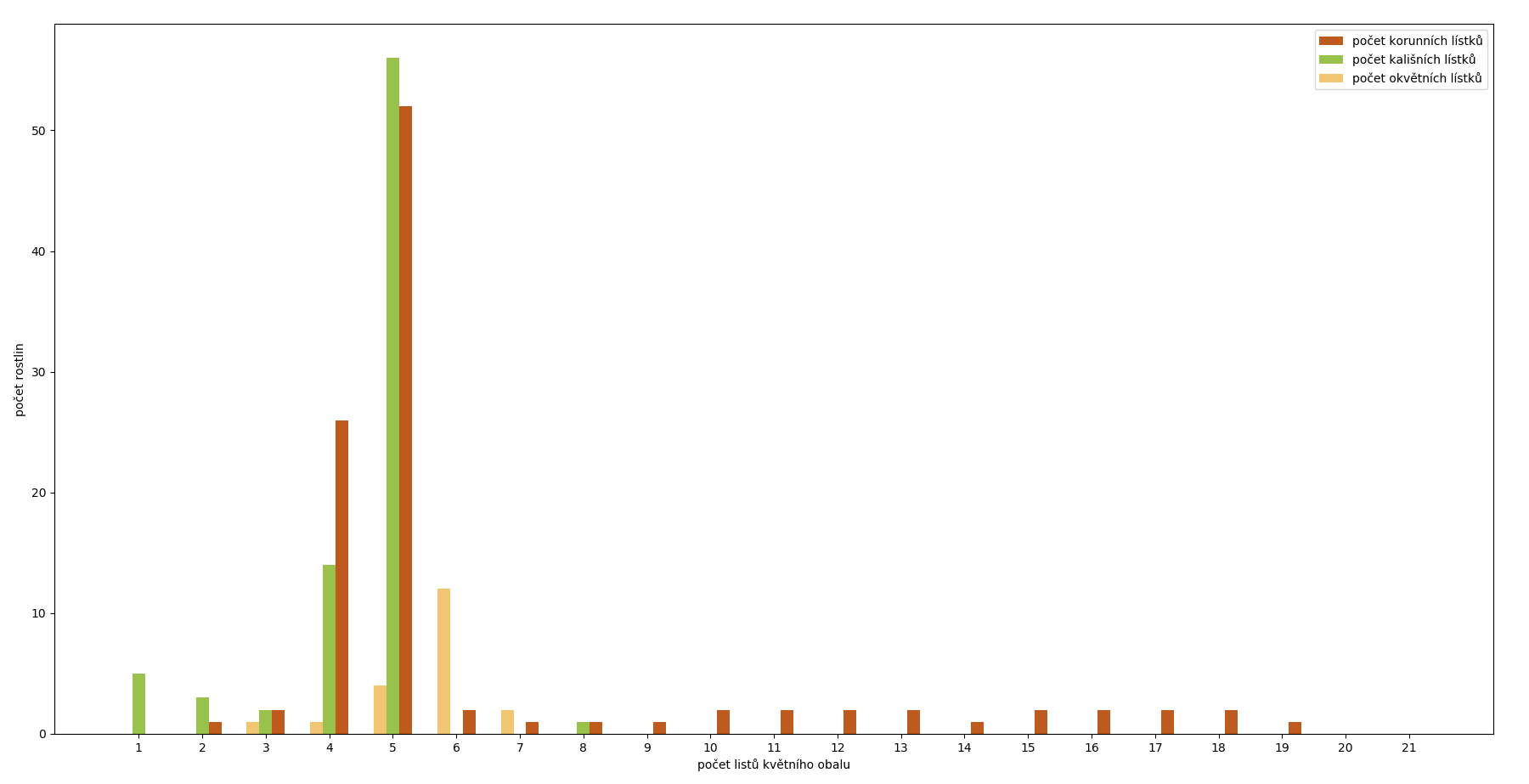
As can be seen from it, flowers most often have 5 perianth segments, which just happens to be a number in the Fibonacci sequence. But that is all, since the second most common case is the number 4, and that is not a number in the Fibonacci sequence. If this claim were true, it would be evident in the graph. The myth is thus debunked; the Fibonacci sequence has nothing to do with the number of petals in a flower’s perianth.
These two myths are certainly not the only ones, but my goal was not to debunk them all, but rather to point out that some things you can find online about the Fibonacci sequence and the golden ratio are nonsense, and it’s always important to think them through first. Of course, I do not mean to cast doubt on the entire Fibonacci sequence; the truth is that it has truly remarkable properties and, in some cases, does indeed occur in nature and in various branches of mathematics. However, these myths and misinformation slightly detract from its beauty.